S1B4 Things in Nature Merely Grow
大家好,欢迎来到这一期的2045, 我是行健。
我读这本书的时候是2025夏天,今天要讲的者本书刚刚出版。 现在是8月份的尾巴,节气中的处暑, 美国的劳动节,都在说这是夏天的结束。 加州的葡萄已经结束丰收,开始酿酒。我身边的环境依然树木丛生,百草丰茂。 现在我来时录音,已经是10月分节气里的寒露,秋收的活动已经偃旗息鼓,冬天在悄悄的靠近。 自然在人的时间框架里轮回,人也在自然眨眼微笑的瞬间生长成熟。
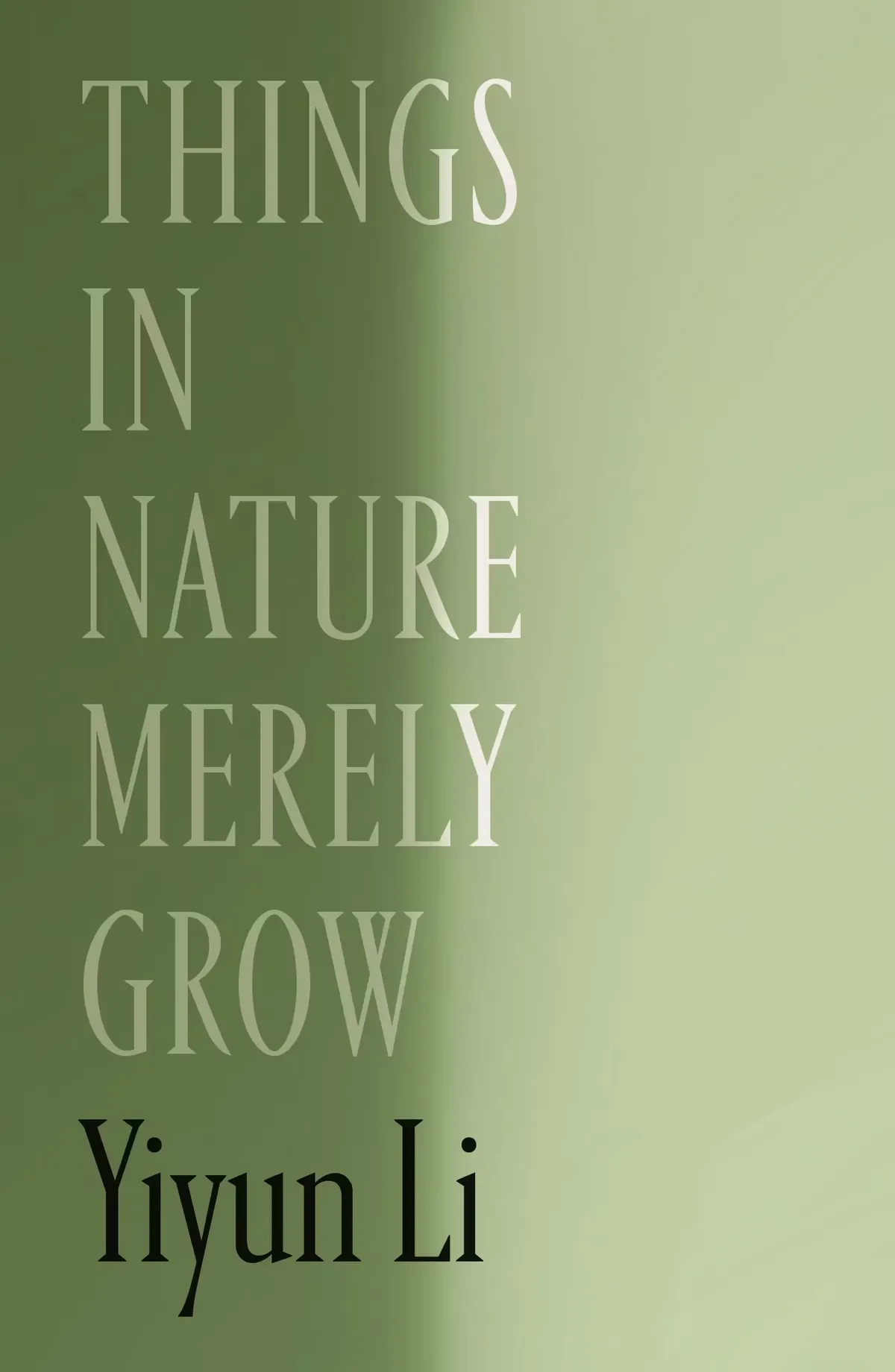
📚 本期分享:李翊云《Things in Nature Merely Grow》
书名是什么意思呢,Things in Nature Merely Grow。 开始书名里的merely抓了我, 自然不过无知虚增。 读了发现是:自然兀自荣枯。虽然Li Yiyun作为作家的母题就是和母亲母语,跟这两者的割裂。 但这一句 things in nature merely grow,却百川归海那样,就是中文里的-物尤如此/木尤如此,人何以堪/白先勇的树犹如此。
看她之前的一篇采访,Li Yiyun将自己喜欢gardening,分享喜欢植物识别app, 她的花园想是百草丰茂。转眼,物是人非,成为她的项脊轩。庭有枇杷树,吾妻死之年所手植也,今已亭亭如盖矣。
这是一本简单明了,但内容沉重的书,是李逸云在第二个儿子自杀之后的自我陈述。
📌 我对李翊云的兴趣点:语言与人物的关系
我感兴趣Yiyun Li的原因大概是几个,一直在分析语言和人物的关系。
《A thousand years of good prayers 2007》的核心:讲另一个语言,像是另一个人一样 她也没有写透,王颖导演也没有拍出来 2005 novel
The phone rings before his daughter replies. She picks up the phone and automatically goes into her bedroom. He waits for the bang of the door. She never takes a call in front of him, even with strangers trying to sell her something on the phone. A few evenings when she talked longer and talked in a hushed voice, he had to struggle not to put his ear on the door and listen. This evening, however, she seems to have a second thought, and leaves the bedroom door open.He listens to her speak English on the phone, her voice shriller than he has ever known it to be. She speaks fast and laughs often. He does not understand her words, but even more, he does not understand her manner. Her voice, too sharp, too loud, too immodest, is so unpleasant to his ears that for a moment he feels as if he had accidentally caught a glimpse of her naked body, a total stranger, not the daughter he knows.
她自己用自己的方式在践行 给了最好的答案和最泾渭分明的选择:不用中文写作。
- 《The Speak is to Blunder, New Yorker》
- 可能deal with 夏志清obsession with China 的最好方式是直接改用另外一个语言。关于夏志清说的obsession with china, 我理解就是缺乏启蒙主义。我们改天找更好的机会讨论。
- 用另外一个语言来写中文里似乎总是有一层玻璃罩让你靠近不了的概念,比如爱。
- 对自己过往的理解。 Yiyun 更加决绝,直接觉得中文的经历都是hate, 放弃起来,毫不手软
纯纯的文学家 开完这本书,我很意外的地方是,li yiyun 是个纯纯的文学家,就是她的知识养和思维框架全部来自纯文学:诗歌,戏剧,小说。没有很多历史,科学,和哲学,没有什么跨学科的思维。所以坦白的讲,不是最能抓住我的作品。我目前个人的兴趣好像觉得纯纯的纯文学有点无聊。需要一点别的认知框架。
勇敢的纯理性人 真实,直面,而且是分析式的语言。非常符合我的
I once edited a few adjectives out of Vincent’s writing when he was in sixth grade, which led him to protest: “Adjectives and adverbs are my guilty pleasure!” 我自己也拿词性开过玩笑。我老婆是名词世界,我是来自动词世界的。我们的文化碰撞和日常冲突总是名词和动词的碰撞。我说,我认识你之前不知道这么多名词。动词总是觉得名词的局限,必须要走出名词,名词总是觉得动词的短暂,最终归于名词。
💔 两个儿子的自杀:悲剧的缘起
这本书,是Yiyun Li 写给自己的二儿子James, 在他自杀之后。而她的大儿子,几年前,也同样在火车站自杀。 Vincent in 2017, at sixteen, James in 2024, at nineteen. Both chose suicide, and both died not far from home; James near Princeton Station, Vincent near Princeton Junction.
我看这本书是想看一个比我更analytical的人,怎么分析这么巨大的悲剧。我想看一个比我更真实的人,怎么真实的描述,这种至亲骤然死去的感受。她需要面对这个事实,面对自己的人生,同时面对自己不知道怎么是一个在美国虽然出版几本书但根本没人问津,但在中国不知道怎么很知名的作家。所有有很多网络的攻击。我非常想知道她的感受,和她是如何应对的。 我想读的一个添加剂最少的文字。
虽然她在英文世界可能是毫无影响力,但在中文世界却是大名鼎鼎,但是读者很少,八卦者很多,我个人觉得很不公平,但也没有很深刻的打抱不平之感,觉得这些没的救的人群和声音,理他干什么。
📖 上集:对孩子的反思与自杀的追问
下面进入这本书。上集我想分享的是,可能是读者最急切想知道的问题,到底发生了什么,这样的悲剧为什么会发生了,孩子怎么了。 下集我想分享的是,悲剧之后,作家是怎样的感受,怎么样去面对的。
💡 第一:对孩子的反思,自杀的追问
我们从大儿子Vincent 的对话开始:去进入他作为一个青少年的suffering
Vincent 的诘问:为何还要生育?
Why would a woman who knew suffering give birth to her children? That question from Vincent—I never had a good answer for him. I advocated for patience, and for the possibility of change—I myself had just returned from the bleakest time of my life, I had in my teenage years come close a few times to suicide, so I understood him, I said, but things might change, and sometimes they might change for the better.
“But do you really believe that things will get better?”
Vincent pressed me once. We were sitting in his bed then. He was a thirteen-year-old who looked all of a sudden very young. The transparent pain on his face reminded me of a much younger Vincent, of the summer before kindergarten. His best friend, Mari, had told him that she might not marry him because she wanted to marry her brother. Vincent returned home in a daze and stayed immobile in bed for hours. What kind of five-year-old feels so acutely the pain that belongs to someone older? After a few hours, Vincent sat up and ripped out an empty music sheet from his piano book. “O LOVE, O LOVE, O HEARTLESS LOVE,” he wrote in block letters. “THROUGH YOUR HEART. FOR YOUR LIFE.” Mari’s mother was in awe and begged for a photocopy of the page. I was in awe, too, but I was also alarmed. I despaired, really. I wished then—and I still wish now—that Vincent had not been born with the capacity to feel what he felt in life. But “wish” is such a weak, useless word. But do you really believe that things will get better? That I did not lie blatantly and offer Vincent blank and vain promises—in retrospect this gives me some solace. I said I could never say things would get better for sure, but that his feelings might change, and he might think differently at a later time. He sighed, and agreed to “give life another chance.” In the end, there are only a limited number of times that one can give something or someone another chance.
学会更好地受苦
Had Vincent lived, had he asked me the question now, I would have answered differently. I know suffering, and I have written well about suffering, but I also know that one’s relationship with one’s suffering can change. For Vincent, I don’t think life would ever have become easier. However, I do believe that we learn to suffer better. We become more discerning in our suffering: there are things that are worth suffering for, and then there is the rest—minor suffering and inessential pain—that is but pebbles, which can be ignored or kicked aside. We also become less rigid: suffering suffuses one’s being; one no longer resists. I wish I had shared these thoughts with Vincent when he was younger. It might have helped him a little, or it might not have changed the course of his life or my life. But wishes are but artificial flowers. I did not know back then that one could learn to suffer better. I did not even know it after Vincent’s death. I learned this only after James’s death. I do not know if these thoughts would have helped James at all. For years, he had perfected suffering as a state of being, and in the end, he too turned away.
母亲的无能为力 10岁的孩子已经恨敏感了,大人也对他的理解无能为力
That a mother can do all things humanly possible for a child, and yet she can never understand the incommunicable vastness and strangeness of the world felt by that child; that a mother cannot make the world just a little more welcoming so the child feels less alone; that a mother cannot keep that child alive—these are facts I have to live with now, every single day, for the rest of my life.
Vincent的死:活得张扬,死于情感
Yes, that I do know. After Vincent died, a parent of a friend of his wrote that she would always remember Vincent as the child who, in the street lit by an orange lamp, jumped higher, ran faster, and laughed more loudly than all the children around him. She was talking about a night after a school dance, in the first year of high school, but she might also be talking about Vincent in his entire, short life. Vincent lived flamboyantly and demandingly. Vincent died because he did not feel that life could meet him: in poetry, in music, in beauty, in courage, and in perfection.
James 的死:哲思至此,死于思考
James , Very thinking child 提起加谬 已经是不是给出了james自杀的答案
加缪的《西西弗神话》 死前在读的是加缪的西西弗神话,开篇就是:
“There is but one truly serious philosophical problem, and that is suicide. Judging whether life is or is not worth living amounts to answering the fundamental question of philosophy.”
哥哥是最能理解他的人 James是超常儿童, find school boring, 哥哥是最能理解他的人。 li yiyun 找到的主要解释。(如同梵高兄弟一样)
But perhaps that woman had a point. Now that James is on the opposite side of that border separating life from death, the decisions we made for him can hardly be defended effectively. If a child is not, in many ways, compatible with the world, should the parents gently usher him out of his cocoon—his room full of his books and toys, his parents and his brother, who loved him, and understood him more than the rest of the world could? Or should the parents fortify that cocoon to keep him safely there? All those unanswerable questions, though there is one thing I know for certain: Vincent was the most important part of James’s life. What security we had tried to build for James must have disintegrated when Vincent died.
两个孩子的总结
Vincent lived through his feelings, deep, intense, and overwhelming feelings, and he died from his feelings: a life worth living, in the end, did not prove livable; an acutely artistic and sensitive soul might not always have the means to prevail in this world. James thought hard: deeply, philosophically, and privately. He died from thinking: a livable life might not be worth the trouble; a livable life, he must have concluded, was not what he wanted. My intuitions as a mother were such that I understood Vincent’s feelings and foresaw the dire outcome of those feelings, and yet I could not alleviate his pain enough to keep him alive. But with James I was even more limited: I could only reach for his mind without grasping it. My intuitions about James were put into words only once—to James, a few weeks before his death, in fact. Why? I will never be able to answer that question.
10%的活下去的理由
On the last day of his winter break, I had a conversation with James, telling him that by my calculation only ten percent of life is made of things and people we love, and for that ten percent—the real joy of living—we must endure the other ninety percent. I told him that I myself had not had enough understanding of this statistic, so I couldn’t have told Vincent this when he was alive. “But remember, Vincent was a perfectionist,” I said. “So even if I had told him that, that ninety percent of life would have been difficult for him.” James nodded. I then said that my hope was that his temperament—which was calm, dispassionate, self-effacing—combined with his strong intellectual grasp of science, language, philosophy, and logic, would mean that life would remain livable for him. “Always think of that ten percent,” I said to him. In that same conversation I also pointed out to James that his stoicism and his resilience would be things to rely on in life, with which he agreed, not verbally, but with his gentle smile. But I was wrong. A livable life might not have been attractive or engaging enough for James. A livable life fell short at some point. Stoicism could mean that death, like life, could be endured. James died as a result of thinking, not feeling, just as in my own case it was thinking, rather than feeling, that had led me to the border between life and death. One could say that James thought himself into a corner; one could also say that James thought himself out of his loneliness, which was not only about losing Vincent, though losing Vincent must have been the saddest thing that happened in James’s life. His intelligence would have worked better for him had he wanted something more from life. But in a few conversations we had around the time he went to college, he confirmed my fear that he was not interested in anything external or worldly. Wealth or fame would not allure him. Self-expression would not interest him. Knowledge—language, philosophy, history—would give him pleasure, but that pleasure would remain private; he saw little need to communicate it to another person. It was not often that he would find an incentive to speak: if he did not understand something, he could not possibly speak; if he understood something thoroughly, there was no point in speaking.
家庭氛围:自由意志和相互尊重 家庭氛围,核心精神,题眼, free will and mutual respect
After James’s death, I found a picture I had taken when he was in kindergarten. When I went to pick him up, he was wearing a sign that he had written out in large print, no doubt exasperated by grown-ups asking him why he wasn’t talking or telling him that he must talk: IM NOt TaLKING Becuase I DON’t WaNT TO! My husband, referring to the picture recently, made a comment that as a family, what the four of us shared was our belief in, and our respect for, free will. I thought for a moment and replied that despite our not knowing enough of James’s thinking, what we could be certain of was this: he knew that we would respect his decision to take his own life, and he trusted that we would endure his death, as we had done it once before.
值不值得 沉重的题目 加缪开篇第一句,家里三个人都思考了。孩子的结论就是不值得。怎么办。
Life, in an absolute sense, is worth living, just as art is worth pursuing, science is worth exploring, justice is worth seeking. However, the fact that something is worth doing doesn’t always mean a person is endowed with the capacity to do it, or that a person, once endowed with that capacity, can retain it. The gap between worth doing and being able to do is where aspiration dwells for the young and decline lies in wait for the old.
精神科医生的建议:不要问“生命是否值得”
A few years ago, when I met a psychiatrist, he asked me about that unreality I slipped into in 2012, and I said, a little shyly, that everything, in the end, came to that central question—is life livable? And my answer, after months of struggling, had been no. The psychiatrist nodded and then told me an old story from Norse mythology. In the wild darkness there is a long hall, brightly lit, warm, with windows open at both ends. A bird flies in from the window at one end and in a moment dashes out of the window at the other end. That hall, the doctor said, is life, and we’re all birds coming out of the cold darkness for a moment and then returning to the cold darkness the next moment. “My advice,” he said, “is that you never ask that question again. Is life livable? We don’t really have the time to form a thorough and thoughtful answer.”
📝 中集:作家的回击与直面
为什么要写这本书: 就是直接写死亡, though no good way to put it
如果说刚才分享 的部分,是一个抽象的,非常personal的记忆和对话,那么下面这些几个具象具体的点,对外的,公共的交流。
书里几个片段,对网友们,对自己的母亲,对自己的同学的回话。 我其实自己也目前处在一种,觉得这种对外的交流无意义,因为世界的大多数面向和群体都是没救的。我们要做的就是构建自己的茧房,孤芳自赏。 跟自己不喜欢的观点,去碰撞交流,何必呢。 虽然一本书都是自己的千思万绪,李逸云还是花了小小的片段来回击。我觉的,也对,我们都是凡人,把不同意说出来,也是因为这种不适感,是我们的生活动力之一。世界越混乱,我们就越想建立自己的秩序。
📌 第三章:不委婉的谈论死亡
关于“死”这个字
Some people (especially in China) make a fuss about my using the word “die” when I talk about the deaths in my life, equating this linguistic decision to coldheartedness or evil. Indeed there are euphemisms one could use. The word “euphemism,” coming from Greek euphēmismós and meaning the substitution of an auspicious word for an inauspicious one, may imply sensitivity, but it may also imply cowardice. It is the latter, rather than the former, that puts people in the mood to censor and demonize. Death, particularly suicide, cannot be softened or sugarcoated. After Vincent died, a couple of mothers asked me if they could tell their children—Vincent’s peers—that he had died in an accident. That they preferred to lie to their children, even though the truth would surely reach those children through their friends, baffled me. I explained to the mothers that their proposal seemed to me a disrespect of their own children and a violation of Vincent’s memory. Not calling a fact by its name can be the beginning of cruelty and injustice.
对读者的宣告:这本书的目的
So, dear readers: if a mother using the word “died” or “death” offends your sensibilities (a journalist from China featured my word choice in a profile of me, which led to disapproval among Chinese readers); if you believe that “love” is a magic word that will make everything all right (as did one of my readers, who confronted me on a book tour, asking me how I could have attempted suicide if I had ever loved my children); if you think I’ve erred by not putting my life in the loving hands of thy god (as an ex-friend of mine believes, telling me after Vincent’s death that he was sent by God and taken away by God so there was no reason for me to feel too sad); if you think suicide is too depressing a subject; if the fact that all things insoluble in life remain insoluble is too bleak for you; and if you prefer that radical acceptance remain a foreign concept to you, this is a good time for you to stop reading. This book is about life’s extremities, about facts and logic, written from a particularly abysmal place where no parent would want to be. This book will neither ask the questions you may want me to ask nor provide the closure you may expect the book to offer. I’ve always refused to use the word “grieving” and I’ve rarely used the word “mourning”—for reasons I shall explain later. This is not a book about grieving or mourning. This book will not provide a neat narrative arc, which some readers may hanker for: from hardship to triumph, from incomprehension to newly gained perception and wisdom, from suffering to transcendence. This book will not provide the easy satisfaction of fulfillment, inspiration, and transformation.
💢 不委婉的谈论爱和厌恶
对母亲的恨与自杀行为 对母亲的恨充斥全篇, 母亲小时候打她的片段 最冷酷的就是和她母亲的争执带来她的自杀行为Her suicidal thought came from her childhood: a dead mother is better than a mad mother
My mother has always maintained that she never mistreated us. “You write fiction for a living, you make up stories, and you tell lies,” she said a few times. The last time she said that to me was shortly before my suicide attempt. My parents were visiting us in California. Two days before their flight, my then therapist begged me to stop them from coming. But that wouldn’t do, I explained to him. He then said, despairingly, “She’s going to kill you.” My mother did not kill me. I tried to kill myself. And the very last thought on my mind was seemingly logical: if I’m losing my grip on this real life and slipping into unreality, I would prefer that my children do not have to deal with a mother gone mad. A question my mother liked to ask us when we were young: do you want a dead mother or a mad mother? According to her, a mad mother would be better than a dead mother. I was never asked what I thought. What would a mad mother do to me? Beat me, berate me, tell me that I was responsible for her bad mood and, especially, that I was responsible for robbing her of her youth. All because of you, she would scream at me, because I had to give birth to you I’m now growing old. Even at seven I knew her logic was horrendously flawed. Nobody knew that I had always thought a dead mother would be better than a mad mother. That thought, too, was on my mind when I felt too bleak to live: it’s not my children’s job to keep me alive; in fact, it’s my job to protect them from myself, if I cannot save my sanity.
那些没救的同学们和人们
I’ve known people—in China and in America—who treasure their malevolence, and who revel in the pain they inflict on others. Whether they do this out of profound unhappiness or a profound delusion of power (or both) I do not know; what I do know is that they cannot be helped, and they cannot help themselves. Some years ago, a middle school classmate of mine committed suicide in Beijing in his thirties. In our younger years he and I were close. He was sensitive, fragile, proud, and lonely—but how else could a boy of artistic and soulful temperament be? Ask Chopin, ask Rimbaud, ask Vincent. My friend was good at painting, I was a budding accordionist, and we loved and excelled in poetry equally. He became a designer, and shortly before his death, he wrote to me and congratulated me because, in his words, I had prevailed in being a dreamer. After his death, our old schoolmates, as a collective group, seemed to have very little sympathy. Rather, there were jokes and there was gossip, as if a young man’s death, especially an artistic and sensitive young man’s death, deserved nothing more than laughter and mockery. I remember feeling relief on my friend’s behalf, rather than pain and loss: the world is a cruel place; why stay here among these cruel people, people who will never dare to go to where you’ve found your freedom?
为什么要写这些:To Philosophize is to Live
I’ve in the past quoted Montaigne: “To philosophize is to learn to die.” And I now know there are other variations:
- To philosophize is to learn to live with deaths.
- To philosophize is to learn to live with those deaths until one dies.
- To philosophize is what one can do while living in an abyss—not lost, but found.
🌻 下集:悲剧之后的面对生活
🚨 开篇:警察的话
开篇第一章非常的出彩:
There is no good way to say this. 这是警察到达她家,让她先坐下,然后说的第一句话。 她已经知道结局,每一帧仿佛恐怖片展开。这个理性的大脑在思考什么 No doubt he was following protocol, and yet the sentence—there is no good way to say this—struck me as both accurate and effective. It must be a sentence that, though nearly a cliché, is not often used in daily conversation; its precision has stayed with me.
🔬 第二:分析当下的感受。分析丧子的母亲的生活
Necessity-driven Life (被“必需”驱动的生活)
The day after James’s death, I said to Brigid, “One has to muddle through this life.” That statement was not accurate. There was something stark and piercing in me, which was much closer to clarity than to muddle, but calling it a muddle took less effort. It was as though I were averting my eyes from a mirror, which reflected my mind to me in such an unrelenting and sharp manner that I was startled by myself, frightened, even. By looking away one could imagine a muddled image, vaguer, softer, and less unsettling. “But you’re not muddled,” Brigid said. For over twenty years she’s been the first reader of my writing, and she never lets a wrong word or a weak sentence slip past. “You’re the least muddled person at this moment.” True, my mind was not—and is not—muddled. Only, language is limited. So here’s Exhibit A: a new alphabet and a new vocabulary cannot be found to describe how I feel. Though I wouldn’t call myself a sworn sibling to grim necessity, nevertheless necessity has been in everything I do since James’s death. Gone are the days when I could afford some degree of automatic living in everyday life: shoes slipped on thoughtlessly (the pair of sneakers that used to be next to my shoes are in a different place now), a local detour taken without conscious thought (this road would lead to the corner where I last said goodbye to James), a quick stop at the university cafeteria (where my colleague and friend Ed and I both hid our faces when James, who was a freshman at Princeton, walked past us; he didn’t notice us). Necessity dictates that attention should be given to all details in this after-time: everything is relevant, everything has weight, and everything leads to a moment in the past, which becomes a memory, which in turn becomes a narrative. When a line of coral-colored hyacinths called Gipsy Queen bloomed next to the garden fence in March, I reminded myself, every time I walked past, to slow down and study them. James was the one to have loved this specific hyacinth; I used to prefer Delft Blue.
Found in Abyss (在深渊中被发现)
So, here’s the fact: I am in an abyss. I did not stray into the abyss. I did not fall into the abyss. I was not bullied or persecuted by others and thrown into the abyss. Rather, inexplicably and stunningly, I simply am in an abyss. I am not lost. The feeling of being lost—a disorientation akin to despair—occurred briefly after Vincent died. I remember, after dropping off James at school, driving under a leaden sky, thinking that there there was nowhere for us to go. But that thought of having nowhere to go, just as the statement that no one would surprise me after Vincent died, was an expression of hyperbole, which is unavoidable in anguish: feelings, unexamined, present themselves as thoughts; even, facts. This time I have been careful not to mistake feelings as thoughts or facts. My feelings: stunned, but not lost. My thought: I am found in an abyss.
Not Anger (没有愤怒)
I did not feel any anger when Vincent died—not at him, not at life, either. But I did feel baffled and wounded by life. That a mother could do all things humanly possible and sensible for a child but still could not keep him alive—this was the fact that I would have to live with, I thought, every single day, for the rest of my life. It was Vincent’s death that made me begin to use that phrase, “every single day, for the rest of my life.”
对Griefing 的反感 (拒绝悲伤)
Grief cheapened by cliché, by wishful thinking, and by self-centeredness of various kinds—this is another reason I never use the words “grief” or “grieving” when I think about my children. “Grief” is a word used often in those emails sent to me. We like to set our hearts on a finish line, hoping to take the right actions so that we can reach that finish line fast and with the least hassle or pain. Perhaps this urge reflects a desire to mark time in a different way: to harness time for gain. And yet in life, time cannot be harnessed. Marking time after a child’s death is not about overcoming grief or coming out of a dark tunnel—all those bad words sound to me as though bereaved parents are expected to put in a period of hard mental work and then clap their hands and say, I’m no longer heartbroken for my dead child, and I’m one of you normal people again, so now we can go on living as though nothing had happened and you don’t have to feel awkward around me. I am not a grieving mother. I am the mother who will live, every single day, for the rest of my life, with the pain of losing Vincent and James, and with the memory of bringing them up.
时间的漫长:Another Kind of Newborn (另一种新生儿)
家长是孩子的孩子
When life is full of tasks, obligations, and events, time carries us, too swiftly it seems, for is it not our perpetual protest about life that there is not enough time for this or that? But those who complain about that—myself at different phases of my life, too—forget how fortunate they are: Life does not guarantee that time has the capacity to carry us. Time flies, time is fleeting, but then there comes a moment when time, no longer nimble-footed, no longer winged, is for us to carry. Death, a major disruptor of life, can feel like a black hole, depleting all one’s energy, but death fails to be a black hole in one particular sense: it does not absorb all the time. Those who have to live through the days after a beloved’s death and those who are beset by debilitating depression will know this: time stands still, time feels monotonous, and then time becomes Sisyphus’s boulder. One carries it from morning to night, and if sleep comes, it’s but meager comfort with little relief. Then, one starts all over again the next day. The exhaustion one feels while mourning or battling depression is from that never-ending effort to carry time, an exhaustion similar to that of carrying an infant that refuses to nurse, refuses to fall asleep, and cries all day long. One cannot drop time as one cannot drop a baby; one simply has to carry on.
像计算新生儿一样计算逝去的时间
The immediate days after a child’s death (or the death of any loved one, I think) share something with the immediate days after a child’s birth. Very rarely in life do we count the days as loyally as we count a newborn’s beginnings: a day old, three days old, seven days old, two weeks old, three weeks old—in fact, the only other time the days are counted in such a consistent and mindful manner, in my experience, is after the death of a child: one day gone, three days gone, a week gone, three months gone. And the days, counted so closely, with all those hours and minutes for one to carry, feel simultaneously long and fleeting. One nurses a baby, changes his diaper, holds him until he falls asleep, puts him down in a bassinet or a crib, and picks him up again because a baby is good at startling himself. If one is lucky, one has the time to nap a little before the baby needs a diaper change and the next nursing. One is exhausted, from sleep deprivation, from the inexperience of taking care of a new human being, from cracked nipples and chronically injured wrists, from the wounds from the cesarean section or vaginal tearing, all slow to heal.
孩子总是在帮助家长
The worries, the frustrations, the joys, the surprises—parents rarely know enough about parenting, and yet children, somehow, offer parents the assistance they need; they help themselves grow up. The death of a child is a newborn, too. The death of a child is a newborn that does not grow or change. And those children, gone from the world, are no longer able to help their parents.
很难过 写感受最具体和分析的一段是讲如何回答一个问题: how many children do you have Vincent死后,是how many children do you have James死后,是do you have children? 写的很细致,很让人有感触 在母亲节那一天,她在商店里碰到一个小姑娘买东西给自己的妈妈,小姑娘问她这个问题,她的反应。这个具体的小事写的很能让我身临其境。
🍃 第三:分析睹物思人 Things in Nature Merely Grow
对应中文的 物尤如此 树尤如此
Late last year, I planted twelve hundred bulbs, an addition to the seven hundred and the five hundred from the previous two autumns. The tender green had just been popping out of the stale, winter-long snow when James died, and by late March the bulbs were blooming with abandon. Things in nature merely grow—the line has become a reoccurring thought after James’s death—things in nature merely grow until it’s time for them to die. 但进一步的分析是更值得读的 My garden is not a metaphor for hope or regeneration, the flowers are never tasked to be the heralds for brightness and optimism. Things in nature merely grow. There is no suicidal or angry rose, there is no depressed or rebellious lily. Plants have but one goal: to live. In order to live they grow when they can, and go into dormancy if needed. They live until they die—and either they die as destined by nature or are cut down by other elements in nature. A garden is a placeholder. Flowers are placeholders.
Objects (物品)
It was the seventh day after James’s death, and the New Jersey Transit detective was visiting a second time to return James’s backpack, just as the Amtrak detective had come back to return Vincent’s phone. A case involving life and death never miraculously closes itself at the time of the pronounced death. Objects don’t die. Their journeys in this physical world, up to a certain point, are parallel to the trajectories of the humans to whom the objects belong. Then comes the moment when the separation happens. Vincent’s phone became a phone, James’s backpack, a backpack. They became objective objects, left behind in strangers’ hands. Few objects speak. The phone and the backpack were reticent, so they could do little to illuminate the last moments of my children’s lives. Many objects outlive people—this thought has often occurred to me when I see in a museum an eighteenth-century pianoforte or a twelfth-century sword or a bowl from 500 BCE. All of Vincent’s belongings and all of James’s belongings have outlived them; not a single item has left our care. There are Vincent’s many paintings hung around the house. There is James’s collection of pocket watches on a shelf. Everywhere I turn in the house there are objects: their meanings reside in the memories connected to them; the memories limn the voids, which cannot be filled by the objects.
狗的生命 (The Dog)
写狗的这一段惊讶的让我眼眶湿润 心跳加速
Quintus joined the family at eight weeks old when Vincent was ten and James seven. Now an old dog, Quintus moves gingerly on the stairs. Sometimes he bumps into the furniture and looks sheepishly embarrassed. His joints are stiff and his eyes are nearly entirely clouded by cataracts. Two months after Vincent’s death, I packed up his clothes for the move to the house he would not live in. Quintus lingered around the whole time, sniffing the suitcases. “Do you want a brother, Quintus?” I once heard James ask. They were both lying down on the carpeted landing. We had just moved into the house. After James moved into the college dorm, any small noise upstairs would make Quintus, who is not keen to climb stairs, rush up to check James’s bedroom or his playroom. But in the past few weeks, Quintus seems to have gotten used to this new reality. He only goes to James’s rooms when I go there. Oblivion is a kind of blessing, too, though one I would prefer not to have to experience. For weeks I have been trying to remember where Quintus was when the police came to tell us about James. I could place everyone in that scene, but Quintus was not around. He must have gone back to his bed. Children die, and their dog goes on living.
好的,这是博客文章剩余部分的Markdown格式:
✨ Facts (事实)
What do you call parents who can no longer parent? I stop myself from saying parents who no longer have children. Death does not alter the fact that they are as much our children now as they were ten years ago. One of the very few things that surprised me, after Vincent died, was that he did not stay forever sixteen, as I mistakenly said he would, in the book I wrote for him. James grew, turning thirteen, fourteen, fifteen, sixteen, so Vincent did grow too. And yet, only a few weeks before James died, feeling all of a sudden as though caught in a trance, I said to Elizabeth that somehow I felt stunted by life, and had never really moved away from when I was forty-four, when Vincent died. The facts, however, remain as they are. I am fifty-one at the time of writing this book. And we are parents who can no longer parent. The noun form of the word is forever disconnected from its verb form. And it’s the verbs, if one thinks about it, which tend to bear the brunt of death. Mothers are always mothers: some, now buried, can no longer mother their children; some, having lost their children, have no one to mother. (And some, mistaking “to give birth to” as “to mother,” have never known the meaning of how to be a mother.) Verbs can die, too, when children die. Dead verbs are like bees and ants and butterflies enfolded by the amber of time: to parent, to mother, to shape the pancakes beyond the letter Z. The verb that does not die is “to be.” Vincent was and is and will always be Vincent. James was and is and will always be James. We were and are and will always be their parents. There is no now and then, now and later; only now and now and now and now.
🧭 第四:怎么分析和面对 to philosophize is to live
继续自己的生活框架,继续写作,继续游泳,继续做了一个比赛的评委。让自己继续日常的活动,停止无尽的思考
活下去,去爱
Children die and parens go on living Dying is hard. Living is harder. Even harder is living on when life is fractured by timeless deaths. It takes an instant for death to become a fact, a single point in a time line, which eclipses all things in the past and eliminates any possibility for the future. Death is like Euclid’s definition of the point in geometry: “A point is that which has no part.” Living, on the other hand, is not about a single point. There is not a single point in time or space that can become life itself. Children die, and parents go on living. Those parents go on living because that’s the only way for them to go on loving their children, whose deaths easily turn them into a news story one day and gossip the next day, and then, eventually, statistics. Children die, and parents go on living, except they go on living in a different way than they did before. It’s like living with “a new knowledge of reality,” I wrote to my friend Deborah a couple of weeks after James’s death, quoting the last line of the last poem of the collected poems of Wallace Stevens, titled “Not Ideas About the Thing but the Thing Itself.”
生死:两只手
无尽 Sometimes a mother and a child are like two hands placed next to each other: only just touching, or else with fingers intertwined. Then the world turns, and one hand is left, holding on to everything and nothing that is called now and now and now and now. 生死 Two hands The night after Vincent died, I sat up all night, not daring to lie down. I dreaded sleep, for fear that when the morning arrived, there would be a brief moment—no more than ten seconds—when what had happened and what had not happened seemed interchangeable. I dreaded that plummeting from not remembering to remembering. I would rather stay awake all night so there was no mistake, no illusion, only the abyss from where I could not fall further. Death is one reality, life is another. The two realities are rarely compatible. Sometimes one reality obliterates the other, or, worse, banishes the other into the realm of unreality. I remembered texting Brigid that night, asking her to always remind me of this cold, cold fact—that Vincent died—if ever I were not to believe it. The saddest and yet the most irrefutable truth: when you lose a second child, you have already learned a few things about losing a child from your previous experience. The second time around I knew neither to battle life nor to battle death: in both endeavors, there would be unlimited exhaustion and very little to gain. If death is one reality and life is another, I would rather they were like two hands placed next to each other—barely touching or with fingers intertwined. The two hands are not arm wrestling; they cannot beat or dominate each other.
区分:Pebbles Are Not Boulders (卵石不是巨石)
Pebble vs. boulder; pebble: not worth looking at, boulder: Sisyphus the question whether she is the worst mom is a pebble, not worth answering. Do things that make sense—which, in the immediate days after James’s death, included studying geometry, reading a textbook on linguistic logic sent by Christiane, opening myself only to people who have the real strength and understanding just to be in the starkness of my life with me for a moment. More important to myself, do things that make sense means one must pressure one’s thoughts and recognize that some automatic thoughts are but pebbles. The analogy of pebbles was given to me by Brigid when she stayed with us the weekend after James’s death. In a moment of self-pity, I blurted out—“Am I not the worst mother in the world?”—to which Brigid replied that we both knew the answer to that question, and we also knew the question was not a real question, only, a pebble of a question. Better kick the pebble out of your way instead of letting it stop you, she said. If one is destined to live as a Sisyphus in an abyss, there is good sense in distinguishing a meaningful boulder from insignificant pebbles. A Sisyphus making a boulder out of a pebble would only become a comedy. In the past few months I’ve developed a habit of scrutinizing my mind: is this thought a pebble of a thought, is this worry a pebble of a worry, is this question, seemingly unanswerable, only a pebble of a question?
无尽的反问与共存
Life is stubborn. So am I. I have conceded to make this abyss my habitat, every single day, for the rest of my life. But I shall live in this abyss only on my terms. I suppose many people, looking at my life, ask some variation of the question, aloud or to themselves: How did this happen? Every single day, as I pause in the middle of typing, or cooking, or reading, or practicing on the piano, or as I pause on the stairs, going up, going down, I can hear myself say: How did this happen? How can this be possible? How did I end up in this extremity called my life? It is a fact that these questions, unanswerable, fill in the gaps between two moments. They are not pebbles. They are not temporary. They make up that boulder that I cannot carry out of my abyss; my only way, so far as I can see, is to coexist with this boulder, in this abyss. Two hands, barely touching.
📝 结尾:持续思考与行动
我也说不清楚这本书的沉重给我留下了什么,我只能说,人是thinking 和 feeling 的。人在不同的阶段两者的比例也不同,我也觉得对我而言thinking 是更容易理解的。每个人都要去面对生命中的苦痛,我一直期望自己有框架去容纳很多东西。
As people get older, everything become more thinkingly. Just the reason why I wants to read this book Those who have learned swimming in their childhood tend to swim unthinkingly. For some people, the same must be true in life; for them living is a natural process. This has never been the case for me or for my children. I now go to the pool at six thirty in the morning, and I am still the slowest swimmer. Swimming was something I learned for my children’s sake; it’s something I do for myself now. I count between breaths, I kick my legs, I stretch my arms, calculating the angle at which my hands enter the water, I turn my head—all these movements, all action verbs, require some conscious thinking.
书里的感动,勇敢,和bouldervs. Pebble, 西叙福的石头,让我还是觉得是很有价值的阅读体验。我很感谢她诚实的把这些写了出来。
What do you call parents who can no longer parent? I stop myself from saying parents who no longer have children. Death does not alter the fact that they